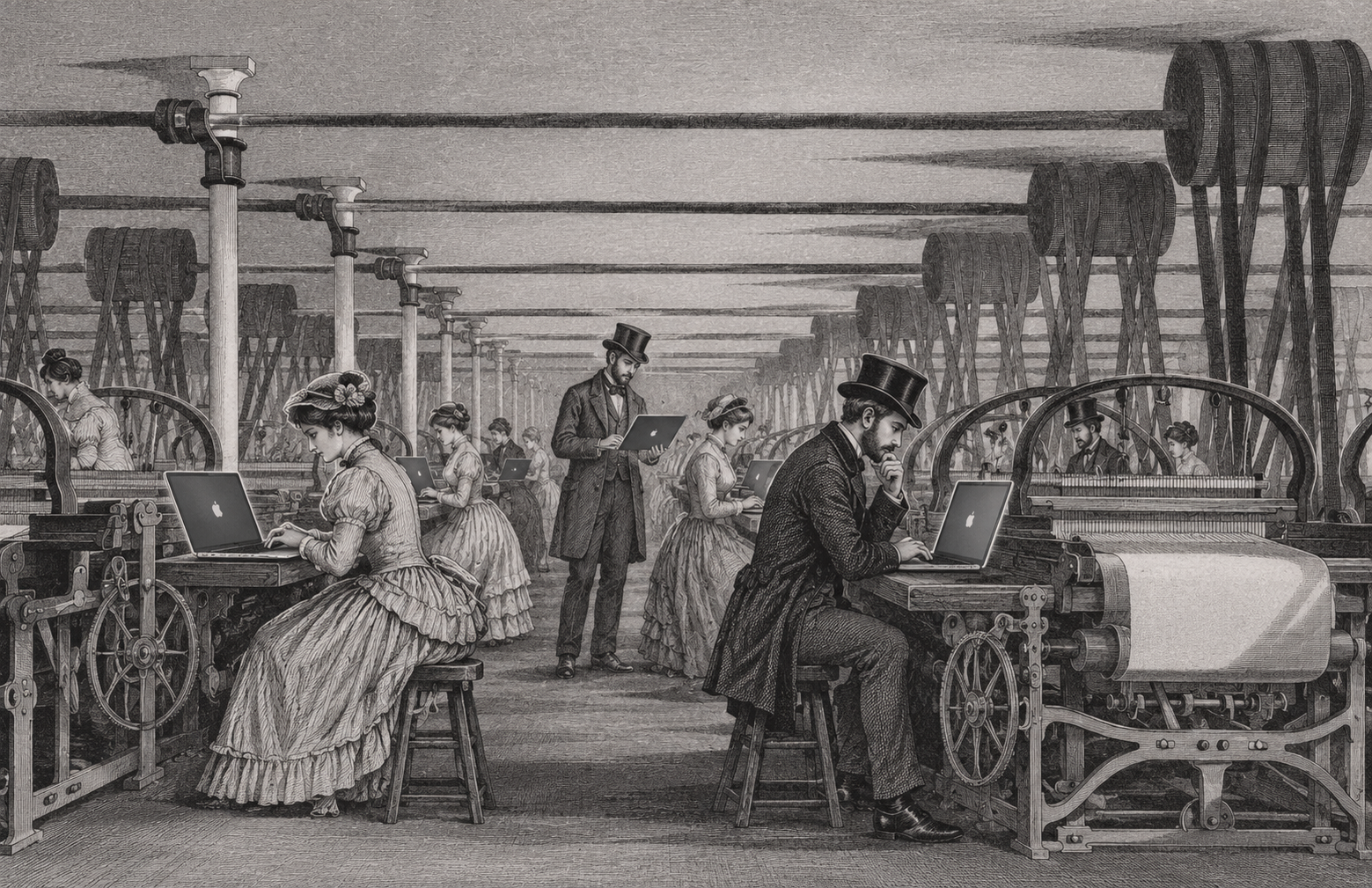

Much like how industrialisation changed the world, so too will the use of software factories driven by artificial intelligence. In a way, these ideas have been around for a long time, and looking at history can help us anticipate the future of software and better navigate the present.
The constant shift of innovation
Imagine a factory that produces mechanical components: it has raw inputs like metal, energy and designs, and has outputs which are the components themselves. These components end up being used in other things like cars or planes each of which have their own industrialised production factories. And throughout the whole process, there are humans involved. People are involved with the ideas and the design phase of the components, the ideas and the design of the machinery of the factory, the inception and improvement of processes and the reviewing of quality, and more.
There are lots of parallels with this factory and software and AI. Before that factory existed, those same components were already being made, by a team of people who may have had some specialised skills such as casting, forging, moulding, engineering and so on. These people also worked a process that had been iterated over a long period of trial and error. They themselves were replaceable by anyone with the requisite skills. These new factories were completely replicable and became homes of determinism, and defect rates got progressively lower thanks to the feedback mechanisms of internal quality checks.
Then came the dawn of machines. Suddenly, a team of people could be replaced by CNC tools and the output remained just as good, if not improved. The factory owners realised these machines did not need to sleep or eat or have Christmas off. They could simply work as required day and night and keep going as long as they were maintained and fed the input and instructions.
But what became of the people? Some of them tried to destroy the machines – these are the Luddites. Some who had lots of knowledge and experience were brought into the conversation about how to use these machines effectively. Some went the other way and became more focused on quality. Some went to work for the machine companies to help maintain the very beasts that replaced them. And some got lost. There were of course a small handful who saw limitless opportunity and decided to replicate this new model of working for themselves and create their own factories which implemented their ideas.
And the skills that these original people had? Some of them were absorbed by the machines and effectively codified into the routines and subroutines. Some of them were absorbed by processes. Some were lost. And some were retained and kept alive through the niches of boutique creations and developed into art forms or services.
This shift also left a gap. Once the requirement for these skills had dropped, they became less desirable to learn due to the lack of work available and the value ascribed to them. But this means they also became harder and harder to learn, due to the shrinking pool of people left to pass them on.
Same pattern, faster pace
We can see this happening in the world of ‘tech’ again. For many years (‘the glory days’ as many may remember it), humans have been the ones architecting, coding, testing and iterating. And now that AI is here, and likely here to stay, humans are wondering what their roles are. The underlying craft has become process driven, and while there are lots of ongoing debates and discussions about the best practices and so on, the change has been rapid.
Industrialisation took around a century, but this shift is happening at a faster pace. So what will become of the people who were the factories and the engineers?
History can give us an answer. Some will rail against the changes and attempt to destroy or delay the AI transformation – perhaps we can call these the CRUDdites (if you know, you know). Some who have lots of knowledge and experience will be brought into the conversation about how to use AI effectively. Some will go the other way and focus on how to improve the output of AI. Some will go and work for AI developers and become part of the companies and teams bringing new models, ideas and processes and innovate in this field (such as sensory AI, non-LLM capabilities, AGI etc.). Some will be lost. And some will seize the opportunities to build new companies, new organisations and new capabilities beyond our imagination.
And what of the skills? It’s likely that some will be embedded in the AI models, harnesses, and yes, even ‘up-skill’ themselves. Some skills will be absorbed by processes. Some will be lost. And some will be kept alive by people who love what they do and want to keep doing it. Handwritten code and 100% free range human developed software may become a niche, but there will be people who will do it because they care about it.
Looking into the future of Software and AI – and who leads it
There is still much work to be done, and humans still have a massive role to play. Regardless of experience, technical people will still always be in demand, and that is because of their problem-solving mindset and ability to innovate in constraints and context. That is largely because humans have something that AI does not: desire. A desire to understand, explore, ideate and improve. AI does not ‘want’. It does as it is directed. (Though if it learns to have its own desires, that is a different conversation entirely.)
In practical terms, this means that while humans’ involvement in the loop may diminish, just as it did with industrialisation, human ownership of the loop will only grow. And so we need excellent, responsible people who are both custodians and drivers for these loops that drive our species onwards.
It’s important that we grow these people, and give them the ability to learn and develop and bring their own ideas into how to run these loops for themselves. There is cause for cautious optimism here. While one door may be closing, many more are opening. The key thing to remember is that humanity is still in the driving seat. We still have choices to make.
One of those choices is to what degree organisations transform with AI. AI exists, but it’s not inevitable, and plenty of organisations can thrive without it. One answer is a conscious choice to preserve the existing technology team and believe in their capability. Another answer is to go completely the other way, where AI is the only thing that matters.
Realistically, there is likely to be some form of incremental adoption broadly across organisations at a pace which follows the speed of understanding, especially from a leadership level. There have to be good reasons for any transformation, and AI adoption is no different.
To conclude with a malaphor: To improve is to change but to err is human.